
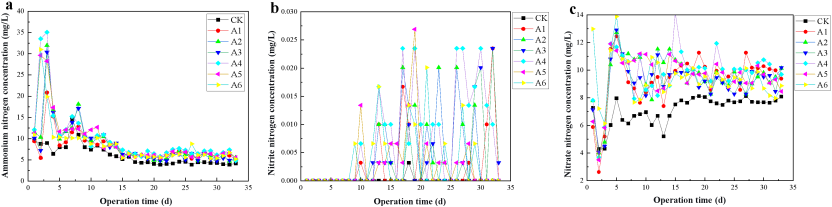
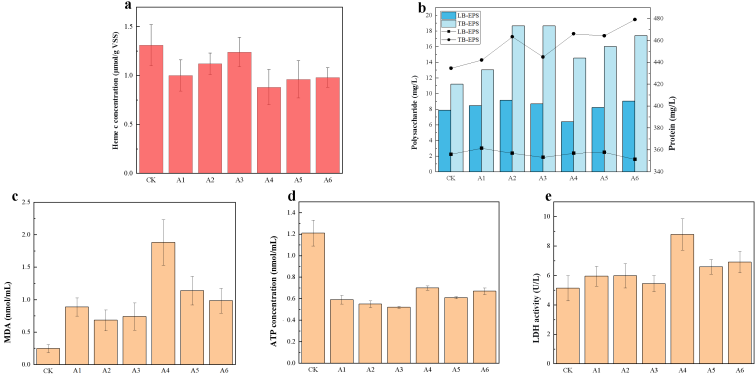
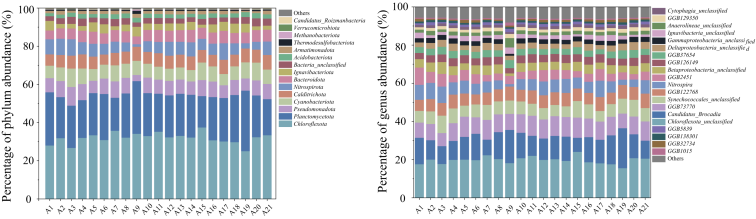
Microplastics (MPs) are pervasive emerging contaminants in wastewater, potentially affecting microbially mediated nitrogen removal process. However, the intricate interactions between MPs and anaerobic ammonium oxidation (Anammox) remain poorly understood. To address the potential threat posed by MPs in municipal wastewater to Anammox process, this study established sequencing batch Anammox systems spiked with colored polyethylene MPs to investigate their impact mechanisms on nitrogen removal efficiency, cellular survival strategies, and microbial community structure dynamics. The results indicated that MPs significantly inhibited nitrogen removal, with NH4+-N removal efficiency in the aged red MPs group decreased to 71.0%. Toxicological mechanism analysis revealed that aged MPs exacerbated cellular oxidative stress, leading to a malondialdehyde content 7.6 times higher than that of the control. This induced severe membrane damage, reduced energy synthesis, impaired electron transfer, and weakened stress resistance, thereby inhibiting nitrogen removal and Anammox activity. Metagenomic analysis further suggested that aged red MPs reduced the abundance of Planctomycetota by 54%, with decreases of 32.3% and 40.3% for Candidatus Brocadia and Candidatus Kuenenia, respectively, indicating that aged MPs significantly inhibited the proliferation of Anammox microbiome. This study elucidated mechanisms underlying suppression of Anammox by MPs, providing a theoretical basis for MP risk management in wastewater treatment.
| Published in | American Journal of Environmental Science and Engineering (Volume 10, Issue 4) |
| DOI | 10.11648/j.ajese.20261004.14 |
| Page(s) | 143-149 |
| Creative Commons |
This is an Open Access article, distributed under the terms of the Creative Commons Attribution 4.0 International License (http://creativecommons.org/licenses/by/4.0/), which permits unrestricted use, distribution and reproduction in any medium or format, provided the original work is properly cited. |
| Copyright |
Copyright © The Author(s), 2026. Published by Science Publishing Group |
Anaerobic Ammonium Oxidation, Microplastics, UV Aging, Nitrogen Removal, Microbial Metabolism
Anammox | Anaerobic Ammonium Oxidation |
AnAOB | Anaerobic Ammonium-oxidizing Bacteria |
MP(s) | Microplastic(s) |
PE-MPs | Polyethylene Microplastics |
PVC-MPs | Polyvinyl Chloride Microplastics |
NPs | Nanoplastics |
WWTPs | Wastewater Treatment Plants |
PET | Polyethylene Terephthalate |
PE | Polyethylene |
PP | Polypropylene |
PS | Polystyrene |
PVC | Polyvinyl Chloride |
UV | Ultraviolet |
UVB | Ultraviolet B |
EPS | Extracellular Polymeric Substances |
LB-EPS | Loosely Bound Extracellular Polymeric Substances |
TB-EPS | Tightly Bound Extracellular Polymeric Substances |
BCA | Bicinchoninic Acid Assay |
VSS | Volatile Suspended Solids |
CK | Control Group |
MDA | Malondialdehyde |
ROS | Reactive Oxygen Species |
ATP | Adenosine Triphosphate |
LDH | Lactate Dehydrogenase |
NAD+ | Oxidized Nicotinamide Adenine Dinucleotide |
NADH | Reduced Nicotinamide Adenine Dinucleotide |
NH4+-N | Ammonium Nitrogen |
NO2--N | Nitrite Nitrogen |
NO3--N | Nitrate Nitrogen |
N2 | Nitrogen Gas |
| [1] | Hadiuzzaman, M., Salehi, M., Fujiwara, T. 2022. Plastic litter fate and contaminant transport within the urban environment, photodegradation, fragmentation, and heavy metal uptake from storm runoff. Environ Res, 212(Pt A), 113183. |
| [2] | Polupoina, P., Mastan, A., Vishnubhotla, Y., Rayalcheruvu, U., Buddolla, V. 2026. Microplastics as chemically active particles: Interfacial transformations, biological signaling modulation, and epigenetic consequences. Next Research, 10, 101874. |
| [3] | Lian, Y., Wang, X., Sun, P., Wang, H., Fang, C. 2025. Occurrence, characteristics and removal of microplastics in wastewater treatment plants with different treatment processes. Chin J Chem Eng, 85, 316-326. |
| [4] | Oshiki, M., Satoh, H., Okabe, S. 2016. Ecology and physiology of anaerobic ammonium oxidizing bacteria. Environ Microbiol, 18(9), 2784-2796. |
| [5] | Nawaz, R., Khurshid, K., Nadeem, N., Iqbal, J., Sakawi, Z., Hanafiah, M. M., Anjum, M., Mahmood, S., Ali, N. 2026. A critical review of anammox processes: Evaluation of their energy and carbon neutrality potential in wastewater treatment. J Environ Chem Eng, 14(3), 122387. |
| [6] | Zheng, J., Yang, Y., Li, Y., Huang, X., Liu, W., Zhang, Q., Ji, X.-M. 2024. Long-term effect of microplastics on anammox systems: From macro efficiency to micro metabolic mechanisms and antibiotic resistance genes proliferation. J Clean Prod, 440, 141032. |
| [7] | Wang, T., Ma, Y., Ji, R. 2021. Aging processes of polyethylene mulch films and preparation of microplastics with environmental characteristics. Bull Environ Contam Toxicol, 107(4), 736-740. |
| [8] | Xue, T., Yang, X., Li, W., Yang, H., Xu, J., Yan, X., Quan, Z., Dong, B. 2024. Effect of polyethylene microplastics on anammox sludge characteristics and microbial communities. J Environl Cheml Eng, 12(6), 114769. |
| [9] | Fan, W., Wei, B., Zhu, Y., Lu, X., Wang, Q., Zhao, S., Jia, W. 2024. Deciphering anammox response characteristics and potential mechanisms to polyethylene terephthalate microplastic exposure. J Hazard Mater, 480, 136044. |
| [10] | Wang, H., Qiu, C., Bian, S., Zheng, L., Chen, Y., Song, Y., Fang, C. 2023. The effects of microplastics and nanoplastics on nitrogen removal, extracellular polymeric substances and microbial community in sequencing batch reactor. Bioresour Technol, 379, 129001. |
| [11] | Ma, H., Zhang, Y., Xue, Y., Zhang, Y., Li, Y.-Y. 2019. Relationship of heme c, nitrogen loading capacity and temperature in anammox reactor. Sci Total Environ, 659, 568-577. |
| [12] | He, S., Zhao, L., Feng, L., Zhao, W., Liu, Y., Hu, T., Li, J., Zhao, Q., Wei, L., You, S. 2024. Mechanistic insight into the aggregation ability of anammox microorganisms: Roles of polarity, composition and molecular structure of extracellular polymeric substances. Water Res, 254, 121438. |
| [13] | Zhao, Y., Qin, H., Lyu, Y., Yan, S., Yu, H. 2025. Study on acute exposure of polyethylene terephthalate microplastics on the performance of anammox granular sludge. Anaerobe, 94, 102984. |
| [14] | Ju, T., Zhang, X., Jin, D., Ji, X., Wu, P. 2024. A review of microplastics on anammox: Influences and mechanisms. J Environ Manage, 366, 121801. |
| [15] | Zhu, Y., Zhong, W., Wang, Q., Fan, W., Lu, X., Zhao, S., Jia, W. 2025. Unveiling the plastisphere in anammox process: Physicochemical evolution of microplastics and microbial succession dynamics. J Hazard Mater, 497, 139789. |
| [16] | Wu, L., Zhang, X., Zhang, X., Wu, P. 2026. Microplastics reshape anammox microbial consortia: Insights into stress adaptation, metabolic interplay, and antibiotic resistance trade-offs in wastewater treatment. Process Saf Environ, 208, 108521. |
APA Style
Zhang, L., Zhao, Y. (2026). Mechanistic Insights into Impacts of Microplastics on Anammox. American Journal of Environmental Science and Engineering, 10(4), 143-149. https://doi.org/10.11648/j.ajese.20261004.14
ACS Style
Zhang, L.; Zhao, Y. Mechanistic Insights into Impacts of Microplastics on Anammox. Am. J. Environ. Sci. Eng. 2026, 10(4), 143-149. doi: 10.11648/j.ajese.20261004.14
@article{10.11648/j.ajese.20261004.14,
  author = {Linlin Zhang and Yongxin Zhao},
  title = {Mechanistic Insights into Impacts of Microplastics on Anammox},
  journal = {American Journal of Environmental Science and Engineering},
  volume = {10},
  number = {4},
  pages = {143-149},
  doi = {10.11648/j.ajese.20261004.14},
  url = {https://doi.org/10.11648/j.ajese.20261004.14},
  eprint = {https://article.sciencepublishinggroup.com/pdf/10.11648.j.ajese.20261004.14},
  abstract = {Microplastics (MPs) are pervasive emerging contaminants in wastewater, potentially affecting microbially mediated nitrogen removal process. However, the intricate interactions between MPs and anaerobic ammonium oxidation (Anammox) remain poorly understood. To address the potential threat posed by MPs in municipal wastewater to Anammox process, this study established sequencing batch Anammox systems spiked with colored polyethylene MPs to investigate their impact mechanisms on nitrogen removal efficiency, cellular survival strategies, and microbial community structure dynamics. The results indicated that MPs significantly inhibited nitrogen removal, with NH4+-N removal efficiency in the aged red MPs group decreased to 71.0%. Toxicological mechanism analysis revealed that aged MPs exacerbated cellular oxidative stress, leading to a malondialdehyde content 7.6 times higher than that of the control. This induced severe membrane damage, reduced energy synthesis, impaired electron transfer, and weakened stress resistance, thereby inhibiting nitrogen removal and Anammox activity. Metagenomic analysis further suggested that aged red MPs reduced the abundance of Planctomycetota by 54%, with decreases of 32.3% and 40.3% for Candidatus Brocadia and Candidatus Kuenenia, respectively, indicating that aged MPs significantly inhibited the proliferation of Anammox microbiome. This study elucidated mechanisms underlying suppression of Anammox by MPs, providing a theoretical basis for MP risk management in wastewater treatment.},
 year = {2026}
}
TY  - JOUR
T1  - Mechanistic Insights into Impacts of Microplastics on Anammox
AU  - Linlin Zhang
AU  - Yongxin Zhao
Y1  - 2026/10/31
PY  - 2026
N1  - https://doi.org/10.11648/j.ajese.20261004.14
DO  - 10.11648/j.ajese.20261004.14
T2  - American Journal of Environmental Science and Engineering
JF  - American Journal of Environmental Science and Engineering
JO  - American Journal of Environmental Science and Engineering
SP  - 143
EP  - 149
PB  - Science Publishing Group
SN  - 2578-7993
UR  - https://doi.org/10.11648/j.ajese.20261004.14
AB  - Microplastics (MPs) are pervasive emerging contaminants in wastewater, potentially affecting microbially mediated nitrogen removal process. However, the intricate interactions between MPs and anaerobic ammonium oxidation (Anammox) remain poorly understood. To address the potential threat posed by MPs in municipal wastewater to Anammox process, this study established sequencing batch Anammox systems spiked with colored polyethylene MPs to investigate their impact mechanisms on nitrogen removal efficiency, cellular survival strategies, and microbial community structure dynamics. The results indicated that MPs significantly inhibited nitrogen removal, with NH4+-N removal efficiency in the aged red MPs group decreased to 71.0%. Toxicological mechanism analysis revealed that aged MPs exacerbated cellular oxidative stress, leading to a malondialdehyde content 7.6 times higher than that of the control. This induced severe membrane damage, reduced energy synthesis, impaired electron transfer, and weakened stress resistance, thereby inhibiting nitrogen removal and Anammox activity. Metagenomic analysis further suggested that aged red MPs reduced the abundance of Planctomycetota by 54%, with decreases of 32.3% and 40.3% for Candidatus Brocadia and Candidatus Kuenenia, respectively, indicating that aged MPs significantly inhibited the proliferation of Anammox microbiome. This study elucidated mechanisms underlying suppression of Anammox by MPs, providing a theoretical basis for MP risk management in wastewater treatment.
VL  - 10
IS  - 4
ER  -
Jiangsu Xinyuan Environmental Protection Technology Co., Ltd, Nanjing, PR China

Information


 Share This Article
 Twitter
 Linked In
 Facebook

 Copy
 Download